
Friday, June 17, 2016

Thursday, June 16, 2016
Outtakes
Or, the title that G suggested for this post, "Sh*t We Saw In Japan."
Here's a realistic glimpse into our vacations through the pics that don't make the first or second or third cut for blog posts.
Not all of our selfies work out.


All. The. People.
In order to get this picture:

We had to deftly navigate our way through this crowd:


The Signs
BLUF (Bottom Line Up Front): I speak 1.5 languages if you count English, some French, and the Hawaiian I picked up along the way. So, no judgement here. But. The signs.


Weird Sh*t
There's weird stuff everywhere, but it sure is fun to photograph on vacation.
The time the deer walked into Mario's store. (Zoom in. Look closely.)

Nothin' to see here, folks. Why don't you turn on around and go back the way you came.

The biggest crosswalk I've ever seen. Five directions at an intersection.

There are no words. We loved every minute of the owl cafe. I've spared you 99% of the pics. I look deranged because I'm so happy.


The scariest ET ever.
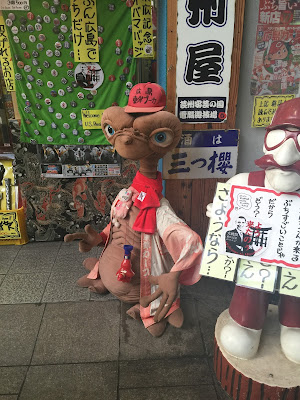
Stuff like this puts my animal mania in perspective. I cooed at the deer. I sweet talked them and fed them loads of crackers. I didn't cuddle with them.

When you go to the temple, you have the option to get your fortune. It involves this process of shaking a big container full of sticks until one falls out. The number on the stick correlates to a drawer system. You find the drawer with your number on it, open it, and pull out your fortune.
But if you don't like it? You tie it up here and leave it at the temple.

Here's a realistic glimpse into our vacations through the pics that don't make the first or second or third cut for blog posts.
Not all of our selfies work out.


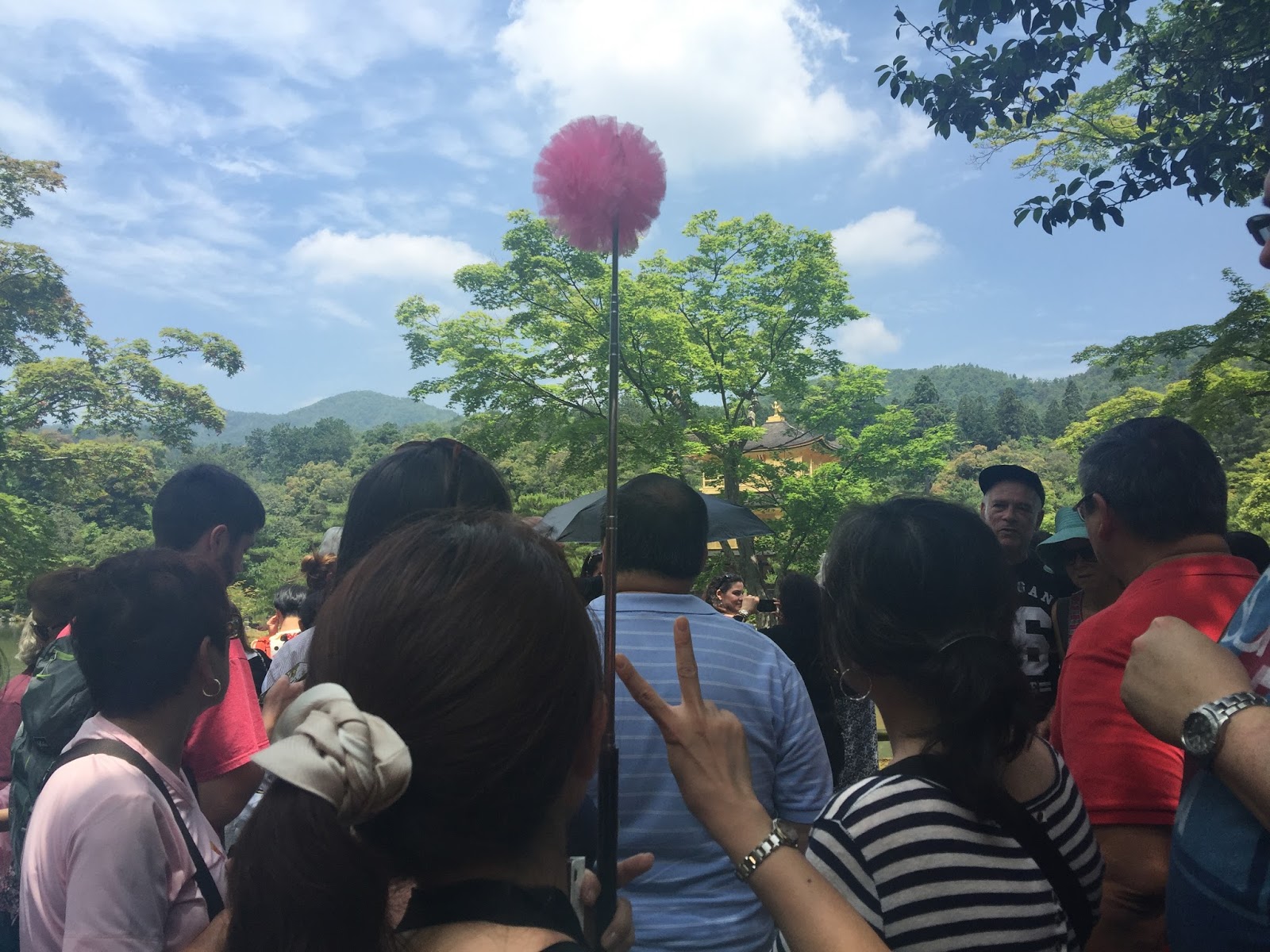
All. The. People.
In order to get this picture:

We had to deftly navigate our way through this crowd:

The Signs
BLUF (Bottom Line Up Front): I speak 1.5 languages if you count English, some French, and the Hawaiian I picked up along the way. So, no judgement here. But. The signs.


Weird Sh*t
There's weird stuff everywhere, but it sure is fun to photograph on vacation.
The time the deer walked into Mario's store. (Zoom in. Look closely.)

Nothin' to see here, folks. Why don't you turn on around and go back the way you came.

The biggest crosswalk I've ever seen. Five directions at an intersection.

There are no words. We loved every minute of the owl cafe. I've spared you 99% of the pics. I look deranged because I'm so happy.


The scariest ET ever.
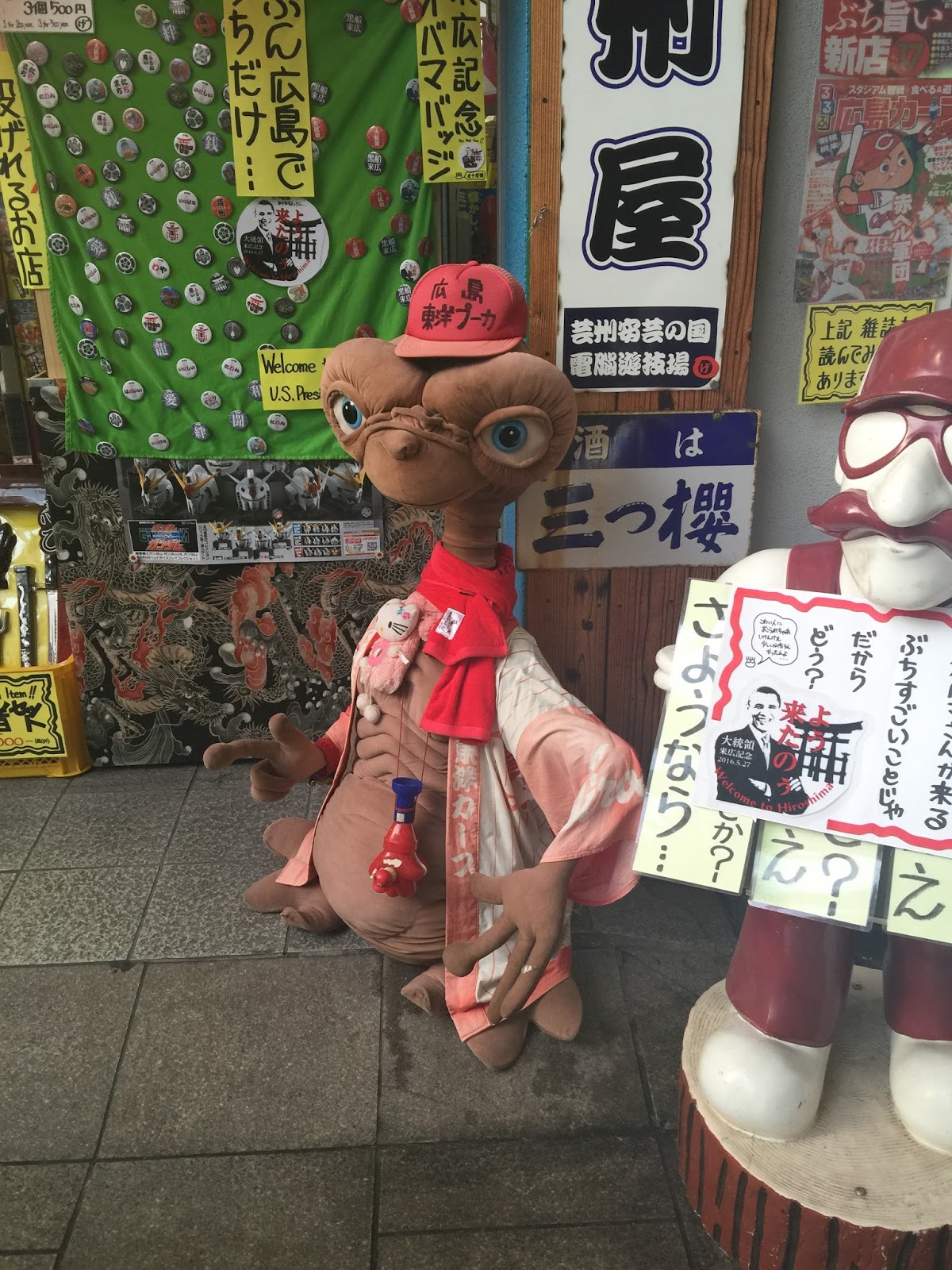
Stuff like this puts my animal mania in perspective. I cooed at the deer. I sweet talked them and fed them loads of crackers. I didn't cuddle with them.

When you go to the temple, you have the option to get your fortune. It involves this process of shaking a big container full of sticks until one falls out. The number on the stick correlates to a drawer system. You find the drawer with your number on it, open it, and pull out your fortune.
But if you don't like it? You tie it up here and leave it at the temple.

Wednesday, June 15, 2016
Mutiny Against Excess
As much as I would love to take credit for the title, it comes from this book:
I took the picture in an attempt at irony - the book crammed in between two enormous suitcases and backpacks while we waited at the Tokyo-Narita airport. But the picture is bad so all nuance is lost.
I've been out of the contemporary Christian world for a few years now. I haven't been actively involved in church or Bible studies, and therefore I've pretty much lost touch with the latest and greatest (or at least the most publicized) of those doing God's work. So, I'm trying to work my way back in. God - and (some of) His people - have been painfully absent in my life and that has been repeatedly brought to my attention over the last few months.
Hatmaker and her husband started Austin New Church, and she has published several books. This is the only one I've read, though when I finished it, I ordered three more. How's that for consumerism? Hardy har har. Everyone knows that there cannot be an excess of books; that is impossible.
In the face of gnawing conviction (is there any other kind? :) Hatmaker decided, somewhat randomly, she admits, on the number 7. She decided to spend seven months giving up seven things in a sort of extended fast. Her intent was, in the spirit of Biblical fasting, to empty herself in order to make more room for God. In this case, the emptying was on multiple levels: she wanted room within her own soul for the Holy Spirit to work, but she also wanted to make tangible room, in her house, in her life, in her habits, in her community, and in her world, so that God could use that space for others.
For four weeks at a time, she adjusted her relationship with:
*food
*waste
*clothes
*spending
*possessions
*media
*stress
As a goal-oriented person, I appreciated this book so much. Hatmaker's attitude is not judgmental: she recounts what she tried, in her own life, based upon her own reasons, life and family situation, experiences, etc. She did not imply that everyone else must do exactly what she did; but she stressed the importance of (godly) self-evaluation and awareness. Her points are backed with scripture, and she is frank about wanting to live not just a godly life, but a good one. Like, a normal one. She didn't renounce all materials, give her house away, and run to the nunnery. But she did take a long and hard look at her materialism and how her lifestyle may (or may not) have affected the welfare or well-being of others.
She was pleasantly surprised in many ways, and I found the book thought-provoking and timely in my own life. One of my goals for the summer is to drastically (<-- I use that word purposefully) reduce our clutter and the amount of things we have in the house. Not only do I want to be more organized, but I want to be more sparse. The things left when the dust settles in August will be the things that add to our life or that help us add to the lives of others. All the extra, all the stuff that has just sat there since we moved in a few years ago, will be gone. And it will not be replaced.
I'm also looking forward to filling the gaps with the spirit, and with enhanced relationships, and - let's be honest - with souvenirs from future trips. :) :) I highly recommend this book; it's thought-provoking on many levels. I'll definitely re-read it.
 |
| 7: An Experimental Mutiny Against Excess by Jen Hatmaker |
I've been out of the contemporary Christian world for a few years now. I haven't been actively involved in church or Bible studies, and therefore I've pretty much lost touch with the latest and greatest (or at least the most publicized) of those doing God's work. So, I'm trying to work my way back in. God - and (some of) His people - have been painfully absent in my life and that has been repeatedly brought to my attention over the last few months.
Hatmaker and her husband started Austin New Church, and she has published several books. This is the only one I've read, though when I finished it, I ordered three more. How's that for consumerism? Hardy har har. Everyone knows that there cannot be an excess of books; that is impossible.
In the face of gnawing conviction (is there any other kind? :) Hatmaker decided, somewhat randomly, she admits, on the number 7. She decided to spend seven months giving up seven things in a sort of extended fast. Her intent was, in the spirit of Biblical fasting, to empty herself in order to make more room for God. In this case, the emptying was on multiple levels: she wanted room within her own soul for the Holy Spirit to work, but she also wanted to make tangible room, in her house, in her life, in her habits, in her community, and in her world, so that God could use that space for others.
For four weeks at a time, she adjusted her relationship with:
*food
*waste
*clothes
*spending
*possessions
*media
*stress
As a goal-oriented person, I appreciated this book so much. Hatmaker's attitude is not judgmental: she recounts what she tried, in her own life, based upon her own reasons, life and family situation, experiences, etc. She did not imply that everyone else must do exactly what she did; but she stressed the importance of (godly) self-evaluation and awareness. Her points are backed with scripture, and she is frank about wanting to live not just a godly life, but a good one. Like, a normal one. She didn't renounce all materials, give her house away, and run to the nunnery. But she did take a long and hard look at her materialism and how her lifestyle may (or may not) have affected the welfare or well-being of others.
She was pleasantly surprised in many ways, and I found the book thought-provoking and timely in my own life. One of my goals for the summer is to drastically (<-- I use that word purposefully) reduce our clutter and the amount of things we have in the house. Not only do I want to be more organized, but I want to be more sparse. The things left when the dust settles in August will be the things that add to our life or that help us add to the lives of others. All the extra, all the stuff that has just sat there since we moved in a few years ago, will be gone. And it will not be replaced.
I'm also looking forward to filling the gaps with the spirit, and with enhanced relationships, and - let's be honest - with souvenirs from future trips. :) :) I highly recommend this book; it's thought-provoking on many levels. I'll definitely re-read it.
Saturday, June 11, 2016
Bunichiwa
We have been back home from Japan for a week already. Time has flown by and I'm worried it's going to continue to do so for the rest of the summer. Things need to slow the heck down so that I can be leisurely and lazy for as long as possible before the semester starts up.
Speaking of leisurely and lazy, Loo Loo Bean is taken with her new friend.


Although she's an antisocial little bully towards us - you know, the ones who feed her and care for her and give her copious amounts of love and bunny kisses - she takes her friends seriously. She grooms them and then they all watch TV together. G, in his role of IT support, is a genius and figured out how to set up our Netflix account on the the TV, so we've all been binge watching The Americans.

What else? I've done absolutely nothing to prepare for teaching Comp II in the fall. I've done some research but not much writing on that article I'm trying to publish, which is due very soon and I'm in complete denial about. There is still the occasional email from a student who is beyond shocked about his or her grade (#growup, #welcometocollege, #gradesarenotamystery #DID YOU LISTEN TO ME AT ALL DURING THE FIFTEEN WEEKS WE HAD CLASS TOGETHER?!).
But!
I developed my Virginia Woolf independent study syllabus and my prof approved it! So that is, theoretically, yet another thing I need to get moving on this summer. The amount of reading is no joke and it turns out I'll only have myself to blame if things go south.
And!
I've read a lot of books and need to fill you guys in. Books Books Books coming soon.
I went on a 10-mile hike yesterday that made me question my ability to make good decisions.


It was hello Colorado beautiful but it was 10 miles. Oh, did I already say that? About it being TEN MILES? I should have thought more about the fact that traipsing 10 miles through the mountains, with no oxygen, is a wee bit different than traipsing 5 or so miles through Tokyo while stopping to buy souvenirs and shaved ice.


G and I have started up our summer bike riding and - while I can't really bear to think about this right now since my body is screaming at me from yesterday's trauma - are planning out an eventful summer of hiking in the Rocky Mountains. We have initiated a weekly date lunch, where I meet him at his work and we catch up over G-friendly foods. Various gaggles of his cousins are about to descend upon our house so I need to start setting up the guest room (read: Lucy's side room) as a dorm, and buy All The Oreos and Cheetos.
What else? I have transformed the front yard and it now looks like functioning humans live here. I'm trying to add a bunch of color with the flowers, and it's working!
I made dark chocolate caramel sea salt brownies from scratch for a get together earlier this week. I may or may not be everyone's favorite person now.


And that, my friends, just about covers it. G is nerding out today with his friends and I'm gonna hit up the annual Garage Sale at REI to see if there's anything I can't live without. Then? More research for my paper and most likely a ton of procrastinating with this one.

Happy Saturday!
Speaking of leisurely and lazy, Loo Loo Bean is taken with her new friend.


Although she's an antisocial little bully towards us - you know, the ones who feed her and care for her and give her copious amounts of love and bunny kisses - she takes her friends seriously. She grooms them and then they all watch TV together. G, in his role of IT support, is a genius and figured out how to set up our Netflix account on the the TV, so we've all been binge watching The Americans.

What else? I've done absolutely nothing to prepare for teaching Comp II in the fall. I've done some research but not much writing on that article I'm trying to publish, which is due very soon and I'm in complete denial about. There is still the occasional email from a student who is beyond shocked about his or her grade (#growup, #welcometocollege, #gradesarenotamystery #DID YOU LISTEN TO ME AT ALL DURING THE FIFTEEN WEEKS WE HAD CLASS TOGETHER?!).
But!
I developed my Virginia Woolf independent study syllabus and my prof approved it! So that is, theoretically, yet another thing I need to get moving on this summer. The amount of reading is no joke and it turns out I'll only have myself to blame if things go south.
And!
I've read a lot of books and need to fill you guys in. Books Books Books coming soon.
I went on a 10-mile hike yesterday that made me question my ability to make good decisions.


It was hello Colorado beautiful but it was 10 miles. Oh, did I already say that? About it being TEN MILES? I should have thought more about the fact that traipsing 10 miles through the mountains, with no oxygen, is a wee bit different than traipsing 5 or so miles through Tokyo while stopping to buy souvenirs and shaved ice.


G and I have started up our summer bike riding and - while I can't really bear to think about this right now since my body is screaming at me from yesterday's trauma - are planning out an eventful summer of hiking in the Rocky Mountains. We have initiated a weekly date lunch, where I meet him at his work and we catch up over G-friendly foods. Various gaggles of his cousins are about to descend upon our house so I need to start setting up the guest room (read: Lucy's side room) as a dorm, and buy All The Oreos and Cheetos.
What else? I have transformed the front yard and it now looks like functioning humans live here. I'm trying to add a bunch of color with the flowers, and it's working!
 |
| See the forest growing behind that fence? That's our backyard. Which I need to tackle. Which I'm currently ignoring. |
 |
| Look at these lil beauties! |


And that, my friends, just about covers it. G is nerding out today with his friends and I'm gonna hit up the annual Garage Sale at REI to see if there's anything I can't live without. Then? More research for my paper and most likely a ton of procrastinating with this one.

Happy Saturday!
Friday, June 10, 2016

Tuesday, June 7, 2016
Hiroshima
I've been thinking about Hiroshima - the bomb part - for a while and, truthfully, there's no good time to write about something this heavy. And yet, truthfully, this topic is important on many levels and demands reflection.
So, what better time to reflect than the day after I got in a huff about a casual encounter with a cashier at Ross? (#firstworldproblems, #getsomeperspective, #privilege)
As I mentioned in my blog post while we were there, the town is lovely. It is beautiful and upbeat and lively and fun.
On the morning of August 6, 1945, an atomic bomb was dropped on the city of Hiroshima by the Enola Gay. (The Enola Gay, in spite of its legacy, is a surprisingly small aircraft. It's housed in the Smithsonian Air and Space Museum in Dulles, Virginia.) The city was just waking up and getting moving. About 600 school children were working on clearing houses in order to create more effective fire lanes.
It is said that America dropped the bomb(s) to swiftly and efficiently end the war. It is said that the bombs were retaliation for Pearl Harbor. It is said that the Japanese were never going to surrender. It is said that the sudden loss of life prevented the further loss of life had the war continued to drag out.
The fire blast following the mushroom cloud obliterated just about everything in a 2-mile radius. Which is why the remaining building - and a handful of trees! - are so miraculous. They are clearly marked. They are set apart within the city.
The pilot of the Enola Gay missed his mark by a hundred meters or so. He was aiming for a T intersection of a bridge. The water under that bridge, a small river which runs through the city, was high that day. It is said that the people on fire rushed into its waters, turning it into a mass grave.


After the blast, people stumbled through the rubble, skin melting off their faces and fingertips. Shredded clothing still remains, on display in the Peace Museum, along with hair, tattered school books, and the rusty shell of a baby's tricycle. There is an entire entrance to a building on display, stone steps, where there is a shadow embedded. The person who had been sitting there simply evaporated, but the split second of the blast preserved the person's shadow in the rock.
Hiroshima was not a military target in the sense that America was aiming to kill soldiers only. While there was a major military command center in the city, this was also, undeniably, a strategic decision to kill a city of noncombatants.
In the museum are petition books in many languages, for people to sign as a plea to destroy all nuclear weapons.
We were in Hiroshima at the same time as the G7 summit. The only thing anyone was talking about was President Obama's anticipated visit to lay a wreath at the memorial. Welcome signs were all over. The American flag hung alongside the Japanese flag on many buildings around the hypocenter area.
Reporters of all kinds, along with police, pretty much took over the city. There were some protests, but they were small and relatively quiet. We saw many people with shirts that said, "APOLOGIZE to the Koreans killed by the A-bomb." (Many Koreans were in Hiroshima at that time, serving as laborers for Japan.)


It is said that America should apologize.
"In the same year that Japan's parliament was debating a resolution to apologize for its role in WWII, George H.W. Bush refused the suggestion that he should apologize for atomic bombs dropped on Hiroshima and Nagasaki. He called the idea of apologizing for the bombs 'rank revisionism'. " **
We were on another island while President Obama and Prime Minister Abe laid the wreaths down at the Memorial and gave speeches. I'm curious to know what Obama said and if there was an apology or a hint of one. I keep thinking I should look it up on the internet. And I keep procrastinating because this is such a depressing topic.
To what extent is the current generation a spokesperson for the past? What role, really, does apology play? And yet, reflection is so important. Can't we express how sorry we are, presently, as we stand in a place of such tragedy?
When we got back to the city that night, after the speeches, we headed over to the Peace Park. People were lined up for blocks and blocks, waiting their turn to see the wreaths placed by world leaders at the Memorial. Waiting for a chance not to see the leaders themselves, but the tangible offerings they left behind in honor of all the innocent people killed. We sat and watched for a long time and I thought to myself, have I ever waited that long for anything?
Our guide that day was from Hiroshima, born and raised. Her parents had migrated from China before she was born, which was over 40 years ago. We tentatively approached the issue of the bomb with her by admitting how pleasantly surprised we were by the city vibe, considering that everything there only existed since approximately the 1950's. She nodded and smiled. We said we didn't know what we had expected, but that the city far surpassed it, that the people were so nice and the feeling was simply "life as usual." She nodded and smiled. If she had anything of import to add, she purposefully kept it from us. But I'd like to think that she simply agreed with us. After all, we had spent the entire day together, talking about Hawaii and the U.S. and the Japanese herds of deer and a variety of shrines and temples. She didn't seem to be one to resist conversation.
But who knows.
**This is an excerpt from an essay titled, "All Apologies" by Eula Biss. It is part of her greater work of essays, Notes from No Man's Land. I highly recommend it. (It's not about nuclear warfare!) :)
So, what better time to reflect than the day after I got in a huff about a casual encounter with a cashier at Ross? (#firstworldproblems, #getsomeperspective, #privilege)
As I mentioned in my blog post while we were there, the town is lovely. It is beautiful and upbeat and lively and fun.
 |
| This building is called the "A-Dome." Located just a few meters from the hypocenter of the bomb, it miraculously survived the blast. |
It is said that America dropped the bomb(s) to swiftly and efficiently end the war. It is said that the bombs were retaliation for Pearl Harbor. It is said that the Japanese were never going to surrender. It is said that the sudden loss of life prevented the further loss of life had the war continued to drag out.
The fire blast following the mushroom cloud obliterated just about everything in a 2-mile radius. Which is why the remaining building - and a handful of trees! - are so miraculous. They are clearly marked. They are set apart within the city.
 |
| One of the trees that survived the atomic bomb. |
 |
| A memorial which contains two flames: one from the Hiroshima fire and one from Nagasaki. |


After the blast, people stumbled through the rubble, skin melting off their faces and fingertips. Shredded clothing still remains, on display in the Peace Museum, along with hair, tattered school books, and the rusty shell of a baby's tricycle. There is an entire entrance to a building on display, stone steps, where there is a shadow embedded. The person who had been sitting there simply evaporated, but the split second of the blast preserved the person's shadow in the rock.
Hiroshima was not a military target in the sense that America was aiming to kill soldiers only. While there was a major military command center in the city, this was also, undeniably, a strategic decision to kill a city of noncombatants.
In the museum are petition books in many languages, for people to sign as a plea to destroy all nuclear weapons.
 |
| The memorial. See the A-Dome in the center? |
Reporters of all kinds, along with police, pretty much took over the city. There were some protests, but they were small and relatively quiet. We saw many people with shirts that said, "APOLOGIZE to the Koreans killed by the A-bomb." (Many Koreans were in Hiroshima at that time, serving as laborers for Japan.)


It is said that America should apologize.
"In the same year that Japan's parliament was debating a resolution to apologize for its role in WWII, George H.W. Bush refused the suggestion that he should apologize for atomic bombs dropped on Hiroshima and Nagasaki. He called the idea of apologizing for the bombs 'rank revisionism'. " **
We were on another island while President Obama and Prime Minister Abe laid the wreaths down at the Memorial and gave speeches. I'm curious to know what Obama said and if there was an apology or a hint of one. I keep thinking I should look it up on the internet. And I keep procrastinating because this is such a depressing topic.
To what extent is the current generation a spokesperson for the past? What role, really, does apology play? And yet, reflection is so important. Can't we express how sorry we are, presently, as we stand in a place of such tragedy?
 |
| This is the view of the Peace Museum from the Memorial. Look at the line of people at the bottom left. |
 |
| This is the view from the Peace Museum, looking back toward the Memorial. See the enormous line of people? |
Our guide that day was from Hiroshima, born and raised. Her parents had migrated from China before she was born, which was over 40 years ago. We tentatively approached the issue of the bomb with her by admitting how pleasantly surprised we were by the city vibe, considering that everything there only existed since approximately the 1950's. She nodded and smiled. We said we didn't know what we had expected, but that the city far surpassed it, that the people were so nice and the feeling was simply "life as usual." She nodded and smiled. If she had anything of import to add, she purposefully kept it from us. But I'd like to think that she simply agreed with us. After all, we had spent the entire day together, talking about Hawaii and the U.S. and the Japanese herds of deer and a variety of shrines and temples. She didn't seem to be one to resist conversation.
But who knows.
**This is an excerpt from an essay titled, "All Apologies" by Eula Biss. It is part of her greater work of essays, Notes from No Man's Land. I highly recommend it. (It's not about nuclear warfare!) :)
Monday, June 6, 2016
Be Nice
While we were in Japan, we experienced a "first" that we never expected: cab drivers thanked us as we got into the car. As in, "Konichiwa! Arigato!" or if they spoke English, something like, "Thank you for my cab today! Thank you!" G and I looked at each other and shook our heads in amazement.
As we nodded and bowed our way around, we noticed that everyone was this nice, this courteous. But in particular, maybe because taxi drivers are not known (broad and sweeping generalization coming!) in America for their people skills or professionalism or even for basic competence, we noticed how much "better" they are in Japan.
Due to myconsumerism greed interest in travel, we took two big suitcases. Because souvenirs. The cab drivers would rush out of the car, and around it, and have the suitcases wrangled into it before we could even settle ourselves into the back. And still they were nice and courteous. Even if only one suitcase would fit into the trunk and the other one had to go in the front seat and the driver had to sporadically reach out to keep it from falling over on him. While he was, you know, driving through downtown Tokyo.

I would think to myself: I'm going to be a nicer person. When we get back, I'm going to be more patient. For real, for real, Jesus, I'm going to work on this.
One of the times we had mercy on G and grabbed dinner at McDonald's, he came to the table with our tray, shaking his head. He told me about the girl behind the counter who helped him. She was Indian, maybe a student? In the midst of work chaos, she spoke to her coworkers in Japanese and swiftly, efficiently switched to English when it was his turn to order. It's a safe bet that both of those languages are foreign to her. Which means that she speaks at least three. And she works at McDonald's.
I thought to myself: Is there ever a case like that in America? Apples to apples - working at McDonald's? Maybe a person speaks one language at home and adds in English at work, but say a Japanese person came in to order. It's safe to say that person would not roll out with Konichiwa and then subsequently carry on a polite and efficient conversation. We don't even do that in English. We don't even do that in whatever other native languages are involved. We are a lot of things in America, but nice is not one of them. (See? Broad and sweeping generalization.)
Today I ran to Ross to grab a couple of essentials. (Summer = yard work and way more exercising = my wardrobe for the next 10 weeks consists of 2 shirts, 2 shorts, and 2 sports bras = I need to build more into the rotation = but I don't want to spend major money = a trip to Ross.) Because I'm a Type A jet lagged early bird, I was there about 30 minutes after they opened and there was only one other customer I could see.
So, it's not like they were busy. They weren't rushing around or anything.
When I checked out, the lady didn't make eye contact with me or speak to me. She stopped mid scan to eavesdrop on a conversation her manager was having behind her on the phone. I just stood there. Because I'm going to be more patient. When she turned back around and resumed scanning, I thought I saw one of those anti-theft devices on a shirt, and I asked her about it. She didn't even respond to me. She just looked at me and rang up the total. So much for patience. I rolled my eyes and paid.

As I walked away and she turned back to her boss's conversation, she mumbled, "...nice day" and I didn't respond because I was almost to the door. Truthfully, I wouldn't have responded anyway.
My plan was to write a post about the differences in Japan (a collectivist culture that values harmony within society) and America (an individualist culture that values efficient conversation/work over societal harmony). I was going to use my irritating Ross experience as an example of America's failing civility, our lack of basic communication skills and niceties. While on the one hand, those can be superficial, on the other they go a long way towards creating a, well, harmonious and civilized society. They contribute to a world in which it is pleasant to live and work and shop. Unlike the Ross, Nice Day lady.
But, something has been bugging me and here's the heart of it: Two days after returning home I've lost all patience. Just like that. Why didn't I smile and say, "You too!" Heck, why didn't I tell her to have a nice day first? How is society going to get any better if I see these problems and just succumb to them (and then judge them and criticize them on the internet) instead of combating them?
Why wasn't I nice?
So, I'm right back where I started, reminding myself that Ghandi once said, "Be the change you want to see in the world."
I'm going to be a nicer person. I'm going to be more patient. For real, Jesus, I'm going to work on this.
As we nodded and bowed our way around, we noticed that everyone was this nice, this courteous. But in particular, maybe because taxi drivers are not known (broad and sweeping generalization coming!) in America for their people skills or professionalism or even for basic competence, we noticed how much "better" they are in Japan.
Due to my

I would think to myself: I'm going to be a nicer person. When we get back, I'm going to be more patient. For real, for real, Jesus, I'm going to work on this.
One of the times we had mercy on G and grabbed dinner at McDonald's, he came to the table with our tray, shaking his head. He told me about the girl behind the counter who helped him. She was Indian, maybe a student? In the midst of work chaos, she spoke to her coworkers in Japanese and swiftly, efficiently switched to English when it was his turn to order. It's a safe bet that both of those languages are foreign to her. Which means that she speaks at least three. And she works at McDonald's.
I thought to myself: Is there ever a case like that in America? Apples to apples - working at McDonald's? Maybe a person speaks one language at home and adds in English at work, but say a Japanese person came in to order. It's safe to say that person would not roll out with Konichiwa and then subsequently carry on a polite and efficient conversation. We don't even do that in English. We don't even do that in whatever other native languages are involved. We are a lot of things in America, but nice is not one of them. (See? Broad and sweeping generalization.)
Today I ran to Ross to grab a couple of essentials. (Summer = yard work and way more exercising = my wardrobe for the next 10 weeks consists of 2 shirts, 2 shorts, and 2 sports bras = I need to build more into the rotation = but I don't want to spend major money = a trip to Ross.) Because I'm a Type A jet lagged early bird, I was there about 30 minutes after they opened and there was only one other customer I could see.
So, it's not like they were busy. They weren't rushing around or anything.
When I checked out, the lady didn't make eye contact with me or speak to me. She stopped mid scan to eavesdrop on a conversation her manager was having behind her on the phone. I just stood there. Because I'm going to be more patient. When she turned back around and resumed scanning, I thought I saw one of those anti-theft devices on a shirt, and I asked her about it. She didn't even respond to me. She just looked at me and rang up the total. So much for patience. I rolled my eyes and paid.

As I walked away and she turned back to her boss's conversation, she mumbled, "...nice day" and I didn't respond because I was almost to the door. Truthfully, I wouldn't have responded anyway.
My plan was to write a post about the differences in Japan (a collectivist culture that values harmony within society) and America (an individualist culture that values efficient conversation/work over societal harmony). I was going to use my irritating Ross experience as an example of America's failing civility, our lack of basic communication skills and niceties. While on the one hand, those can be superficial, on the other they go a long way towards creating a, well, harmonious and civilized society. They contribute to a world in which it is pleasant to live and work and shop. Unlike the Ross, Nice Day lady.
But, something has been bugging me and here's the heart of it: Two days after returning home I've lost all patience. Just like that. Why didn't I smile and say, "You too!" Heck, why didn't I tell her to have a nice day first? How is society going to get any better if I see these problems and just succumb to them (and then judge them and criticize them on the internet) instead of combating them?
Why wasn't I nice?
So, I'm right back where I started, reminding myself that Ghandi once said, "Be the change you want to see in the world."
I'm going to be a nicer person. I'm going to be more patient. For real, Jesus, I'm going to work on this.
Subscribe to:
Posts (Atom)